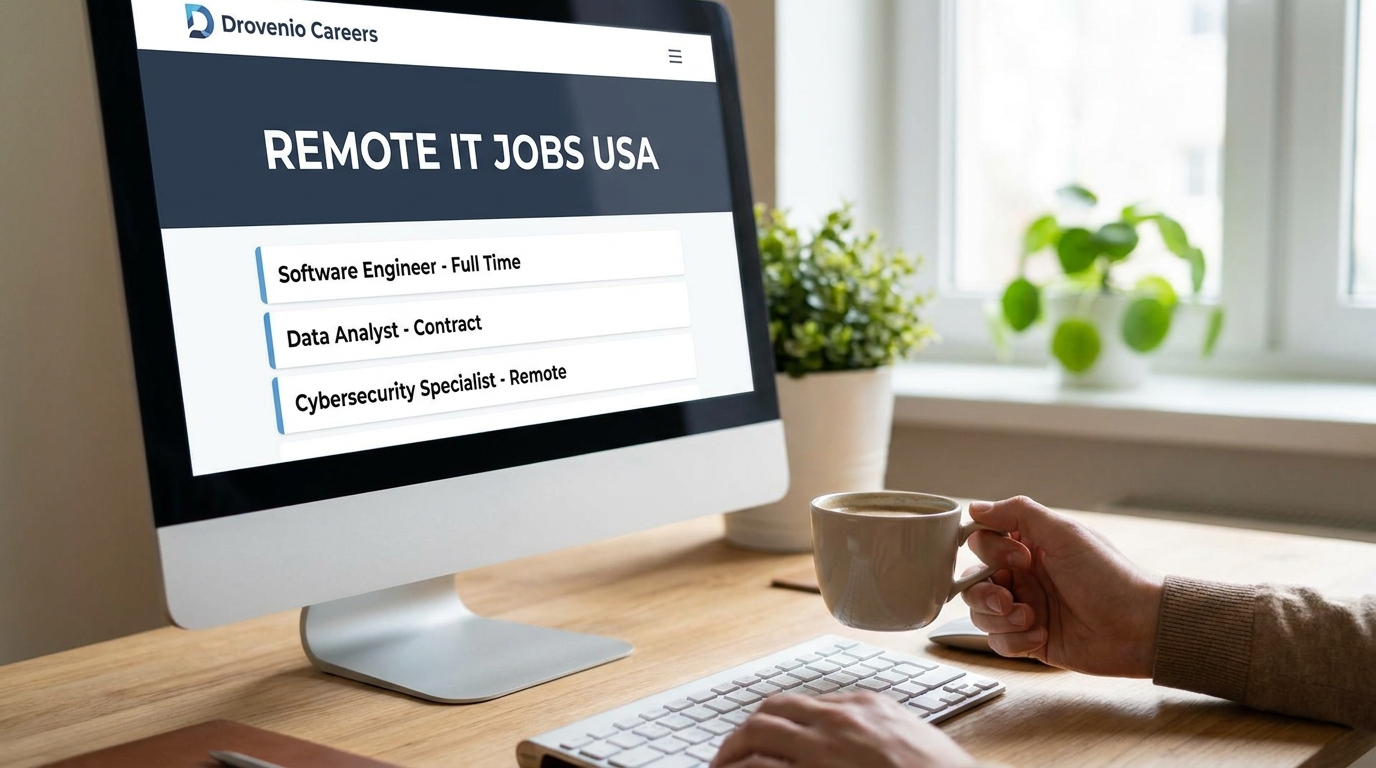
If you have been searching for Drovenio Remote IT Jobs USA, you have probably seen a lot of confusing information. Some websites call Drovenio a job board. Others treat it like a tech platform. The truth is somewhere in the middle.
After reading dozens of articles and talking to remote IT professionals who actually work from home across America, I put together this guide. This is not generic advice you can find anywhere else. This is a practical roadmap for anyone who wants a real remote IT career in the United States in 2026.
Let me start by clearing up the biggest confusion first.
What Exactly Is Drovenio? Truth vs Rumors
Drovenio is not a direct employer. It is also not a traditional job board like LinkedIn or Indeed. Instead, Drovenio represents a growing technology and career ecosystem. It focuses on remote IT work, artificial intelligence, cloud computing, and automation tools.
Many articles online will try to convince you that Drovenio itself hires people. That is misleading. Think of Drovenio as a concept or a content hub. It points toward the direction where remote technology careers are heading. The real jobs exist at actual companies like Google, Microsoft, Amazon, Dell, and thousands of startups across the United States.
So when you search for Drovenio Remote IT Jobs USA, what you are really looking for are remote technology roles that match the modern digital economy. These roles include software development, cybersecurity analysis, cloud engineering, DevOps, and IT support.
Now that we have cleared that up, let us talk about the jobs that actually pay well.
5 Most In-Demand Drovenio Remote IT Jobs in the USA (2026 Data)
Based on current hiring trends from Glassdoor, LinkedIn, and Indeed, these five roles dominate the remote IT market right now. Companies cannot find enough qualified people for these positions.
The first one is Artificial Intelligence or Machine Learning Engineer. This role pays between one hundred forty thousand and one hundred eighty thousand dollars per year. You help build systems that learn from data. It requires strong programming skills and some math.
The second is Cloud Architect. Companies like Amazon Web Services, Microsoft Azure, and Google Cloud need people who can design and manage cloud infrastructure. The average salary ranges from one hundred thirty thousand to one hundred seventy thousand dollars.
Third is Cybersecurity Analyst. With cyber attacks becoming more expensive every year, businesses are desperate for protection. You can earn between one hundred thousand and one hundred forty thousand dollars annually. Certifications help a lot here.
Fourth is DevOps Engineer. This role bridges the gap between software development and IT operations. The salary sits between one hundred twenty thousand and one hundred sixty thousand dollars. You will work with tools like Docker, Kubernetes, and Terraform.
Fifth is Remote IT Support Specialist. This is often the best entry point for beginners. You help employees or customers solve technical problems. The salary ranges from fifty five thousand to eighty thousand dollars. Many successful IT professionals started exactly here.
These five roles are fully remote and actively hiring across all fifty states. But what if you do not have a college degree?
No Degree? No Problem – How to Start Your Remote IT Career
I have met cloud engineers who never stepped foot in a university. I have seen cybersecurity analysts who learned everything from YouTube and free online courses. The technology industry cares more about what you can do than which degree you have.
Here is a five step path that actually works.
Step one is to pick one high demand skill. Do not try to learn everything at once. Choose between Python programming, cloud fundamentals, or cybersecurity basics. All three have free resources on YouTube, Coursera, and freeCodeCamp.
Step two is to earn one entry level certification. I will list the best ones in the next section. A certification proves to employers that you know your stuff without needing a four year degree.
Step three is to build two or three small portfolio projects. For cloud, host a simple website on AWS. For cybersecurity, set up a home lab with virtual machines. For support, document how you fixed someone’s computer problem. Real projects speak louder than any resume bullet point.
Step four is to start freelancing on Upwork or Fiverr. Charge low rates at first to get reviews and experience. One client leads to another. Freelancing fills the experience gap that full time jobs ask for.
Step five is to apply for full time remote roles on LinkedIn, Indeed, Once you have a certification, a small portfolio, and a few freelance gigs under your belt, you become a very attractive candidate.
I have seen people complete this entire journey in six months. You can too.
Top 3 Certifications That Will Get You Hired Immediately
Certifications are not just pieces of paper. They prove to employers that you have specific, testable skills. These three offer the best return on investment for Drovenio Remote IT Jobs USA.
The first one is AWS Certified Cloud Practitioner. It costs around one hundred dollars. You can complete it in two to four weeks of part time study. This certification opens doors to cloud support, cloud administration, and junior cloud engineering roles. Amazon Web Services runs a huge portion of the internet. Knowing AWS makes you valuable immediately.
The second is CompTIA Security Plus. It costs about three hundred ninety two dollars. Expect to spend four to six weeks preparing. This is the gold standard for entry level cybersecurity. Government contractors and private companies both recognize it. Passing this exam tells employers you understand network security, threats, and vulnerabilities.
The third is Google IT Support Professional Certificate. It costs thirty nine dollars per month through Coursera. Most people finish in two to three months. This is perfect for IT support roles. You learn troubleshooting, customer service, networking, and system administration. Google designed it specifically for people with no prior experience.
I recommend starting with whichever matches your interest. Cloud, security, or support. All three lead to real remote jobs.
Step by Step – How to Apply for Drovenio Remote IT Jobs USA
Applying for remote jobs is different from applying for office jobs. You cannot just walk in and shake hands. You need a strategy.
Start with your resume. Add keywords like remote, AWS, Python, cybersecurity, and DevOps. Create a dedicated section called Remote Work Experience. List the tools you have used including Slack, Zoom, Jira, and GitHub. Employers look for these specifically.
Next fix your LinkedIn profile. Change your headline to something like Cloud Engineer Seeking Remote IT Roles USA. Turn on the OpenToWork feature and select remote as your preferred work type. Recruiters search LinkedIn every single day for remote candidates.
Prepare for remote interviews. This is where many candidates fail. Test your internet speed. Make sure your camera and microphone work. Practice explaining your portfolio projects out loud. Research the company remote work culture before the interview. Have good lighting and a clean background.
Now apply smartly. Use LinkedIn, Indeed, Remote.co, We Work Remotely, and FlexJobs. Apply within twenty four hours of a job posting for the best chance. Never ever pay for a job application. No legitimate company asks for money upfront.
Track every application in a simple spreadsheet. Write down the company name, job title, date applied, and follow up date. Send a polite follow up email after one week.
This system works. It removes the randomness and gives you control.
Salary Breakdown – Entry to Senior Level (Real Numbers)
Let me give you real numbers so you know what to expect and what to negotiate for.
At the entry level with zero to two years of experience, you can earn between fifty thousand and seventy five thousand dollars per year. Roles like IT support specialist, junior developer, or help desk technician fall into this range. Even at the low end, you can live comfortably in most of the country working from home.
At the mid level with two to five years of experience, salaries jump to eighty thousand to one hundred twenty thousand dollars. Cloud engineers, security analysts, and DevOps engineers sit here. This is where certifications and portfolio projects really start paying off.
At the senior level with five plus years of experience, you are looking at one hundred twenty thousand to one hundred eighty thousand dollars or more. AI engineers, cloud architects, and security leads earn at the top end. Some specialized roles like machine learning engineers at top tech companies can go above two hundred thousand dollars.
These numbers come from Glassdoor, Indeed, and LinkedIn salary data for 2026. Keep in mind that salaries vary by state, company size, and your specific skills. Cloud and AI roles consistently pay the highest.
5 Essential Tools You Must Learn to Work Remotely
Before you even apply for remote jobs, you should understand the tools that remote teams use every day. Employers expect you to know these on day one.
Slack and Microsoft Teams are how remote teams talk to each other. Learn how to send direct messages, create channels, and use threads. It sounds simple but many people get it wrong.
Zoom and Google Meet are for video interviews and meetings. Learn how to share your screen, mute your microphone properly, and use virtual backgrounds. Test everything before any important call.
GitHub and GitLab are where developers store and share code. Even if you are not a developer, understanding the basics of version control helps. Create a free account and upload a small project.
Jira, Trello, and Asana are project management tools. They track tasks, bugs, and features. Learn how to create a task, assign it to someone, and change its status. This shows you can work in an organized way.
VPN basics are important for security. A Virtual Private Network encrypts your internet connection. Many remote jobs require you to use a company VPN. Understand what it does and why it matters.
All of these tools offer free tiers or trials. Spend one weekend exploring each one. You do not need to become an expert. You just need to be comfortable.
How to Avoid Remote Job Scams (Red Flags Competitors Missed)
Remote job scams are everywhere. They target people who are desperate or new to remote work. Let me give you specific red flags that most articles do not mention.
The first red flag is any request for payment upfront. Scammers will say things like pay ninety nine dollars for your starter kit or pay for background check processing. No legitimate company does this. You should never pay to get a job.
The second red flag is offers that sound too good to be true. Five thousand dollars per week with no experience needed is a lie. Compare any offer against the salary ranges I gave you earlier. If it is way above normal, it is probably a scam.
The third red flag is interviews that only happen on WhatsApp or Telegram. Real companies use Zoom, Microsoft Teams, or Google Meet. They have professional email domains. They do not interview you through text messages.
The fourth red flag is the fake check scam. The scammer sends you a check to buy equipment. They ask you to deposit it and send some money back. The check bounces days later and you lose your money. Legitimate employers ship equipment directly to you or reimburse you through payroll.
Remember this golden rule. If anyone asks for your bank details or any payment before you have a signed official job offer, run away. Close the conversation immediately.
Read: Playing Games PlayBattleSquare
Can International Candidates Apply? Visa and Residency Explained
Many readers ask me whether they need United States citizenship for Drovenio Remote IT Jobs USA. The answer depends on your specific situation.
If you are a United States citizen or a green card holder, you can apply for any remote IT job without restrictions. You do not need any special permission.
If you are on an H-1B or L-1 visa, your options are more limited. These visas are tied to a specific employer. You cannot simply switch to any remote job. You must check your visa terms carefully before applying.
If you are an F-1 student on Optional Practical Training or OPT, you can apply for remote IT jobs related to your field of study. You usually get up to three years of work authorization. Many international students start their careers exactly this way.
If you live outside the United States, some remote jobs still allow you to apply. Companies like GitLab, Zapier, and Automattic hire from anywhere in the world. But many US based remote jobs require American residency for tax or compliance reasons. Always read the job description carefully.
For international candidates, focus on remote first companies that explicitly say they hire globally.
Real Success Story – From Beginner to Seventy Thousand Dollars Per Year in Six Months
Let me tell you about someone I will call Alex. This is a hypothetical story but it is based on real patterns I have seen dozens of times.
Alex had no college degree in technology. He was working a retail job and feeling stuck. He started watching Python tutorials on YouTube during his breaks. After two months, he earned the Google IT Support Professional Certificate.
Then Alex built a small portfolio. He helped a local bakery fix their wifi network and set up professional email accounts. He documented everything and put it on a simple website he built for free.
Next he started freelancing on Upwork. He charged low rates at first just twenty dollars per hour. He fixed computers for elderly clients and set up printers for small offices. He got five star reviews.
After five months of freelancing, Alex had a small portfolio, a certification, and real client reviews. He started applying for full time remote IT support roles. He applied to fifty jobs in two weeks.
In the sixth month, a software company in Texas offered him a fully remote IT support position. The salary was seventy thousand dollars per year with health insurance and paid time off.
Alex is not special. He just followed a system and stayed consistent. You can do the same thing.
Final Thoughts
Drovenio Remote IT Jobs USA is a real opportunity. The demand for remote technology workers in America is higher than ever in 2026. Companies cannot find enough qualified people.
You do not need a computer science degree. You do not need ten years of experience. You need one skill, one certification, one small project, and the willingness to apply consistently.
Avoid scams by never paying for a job application. Learn the basic tools that remote teams use every day. Build a portfolio that shows what you can do rather than just telling people.
The remote IT career you want is absolutely achievable. Start today. Pick one skill from the list above. Spend one hour learning. Then do the same thing tomorrow.
Small steps every day lead to big results over time. Your future remote job is waiting for you.
Frequently Asked Questions
Where can I find Drovenio Remote IT Jobs USA quickly?
Use LinkedIn, Indeed, We Work Remotely, and FlexJobs. Filter by remote and entry level if you are just starting.
Do I need a degree to get hired?
No. Certifications and portfolio projects matter much more than degrees in most remote IT roles.
Which certification should I start with first?
If you want cloud, start with AWS Cloud Practitioner. If you want security, start with CompTIA Security Plus. If you want IT support, start with Google IT Support Certificate.
How long does it take to get hired?
Most people take two to six months from starting their learning to receiving their first job offer. It depends on how much time you can dedicate each week.
Can I work remotely from any state?
Yes for most companies. But some have restrictions due to tax laws. Always ask during the interview process.
What internet speed do I need for remote IT work?
At least twenty five megabits per second download and five megabits per second upload. Wired connection is better than wifi.
How do I explain a gap in my employment history?
Tell the truth. Say you were learning new skills, earning certifications, or freelancing. Employers respect honesty and self improvement.