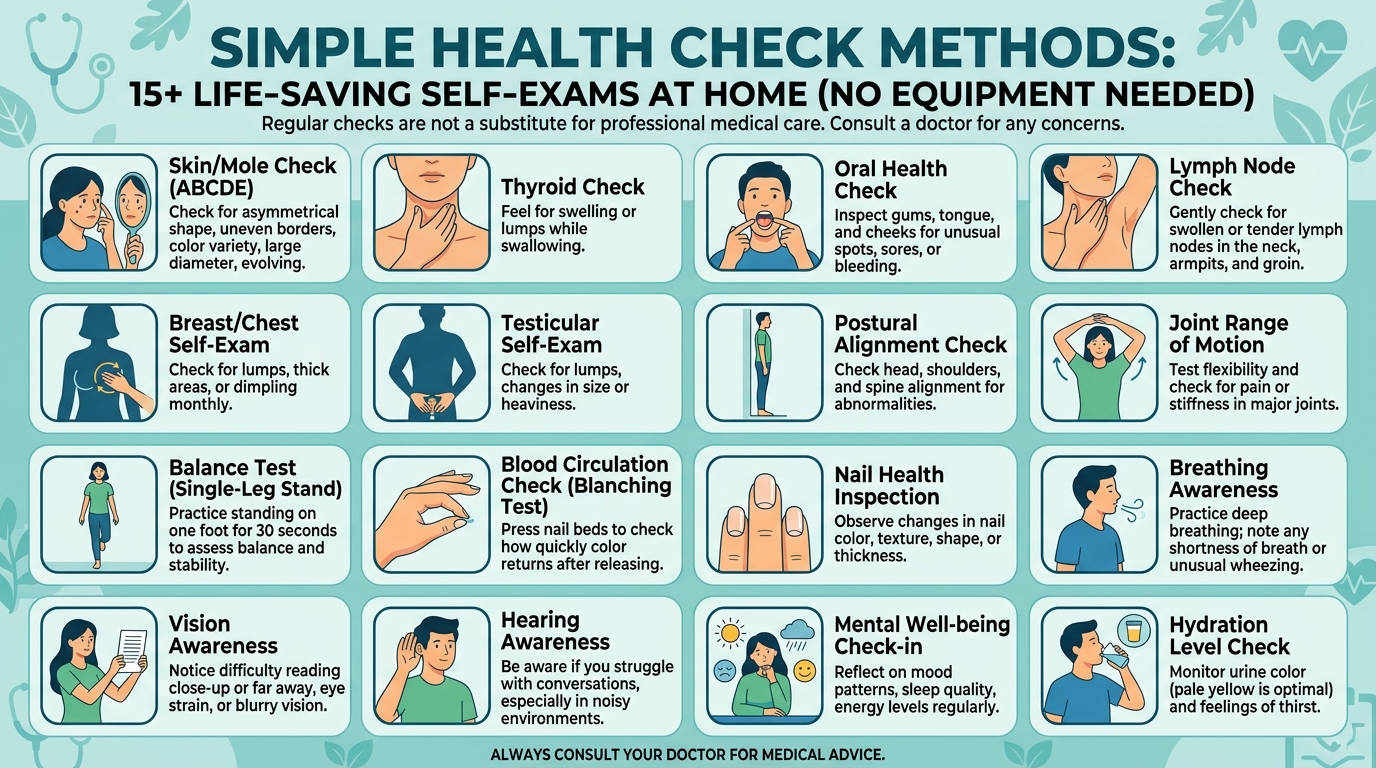
Listen, let me be real with you for a second.
Most of us walk around completely disconnected from our own bodies. We wait for something to hurt, something to feel “off,” or worse—we wait for an annual doctor’s appointment that’s still eight months away.
But here’s the truth nobody tells you: Your body sends you warning signs every single day. The question is—are you paying attention?
Simple health check methods aren’t about becoming a hypochondriac or obsessing over every little twitch. They’re about building a small, consistent habit of checking in with yourself. Think of it like looking both ways before crossing the street. You don’t do it because you’re paranoid. You do it because it’s smart.
And the best part? Most of these checks take less than five minutes. No expensive equipment. No medical degree required. Just you, your awareness, and a few simple techniques that could literally save your life.
So grab a cup of tea, sit down somewhere comfortable, and let me walk you through exactly how to start monitoring your health from home—starting today.
Why Simple Health Check Methods Matter More Than Ever (And How They Save Lives)
Let me paint you a picture.
Sarah is 42. She’s busy. Two kids, a full-time job, aging parents to check on. She notices she’s been more tired than usual lately. Her gums look a little pale when she brushes her teeth. But she shrugs it off. “I’m just not sleeping well,” she tells herself.
Six months later, she collapses at work. Severe iron deficiency anemia. A simple home check—looking at the inside of her lower eyelid or her gum color—would have caught this months earlier.
Here’s what nobody talks about: Most serious health conditions don’t start with dramatic symptoms. They start small. A slightly faster resting heart rate than last month. A mole that’s changed shape but you’re not sure when. Feeling winded climbing stairs that never bothered you before.
Simple health check methods bridge that gap between “something feels different” and “why didn’t I notice this sooner?”
The science backs this up completely. Regular self-monitoring catches abnormalities early—often years before they’d show up on a routine blood test or physical exam. And early detection? That’s not just a buzzword. For conditions like melanoma, breast cancer, testicular cancer, and cardiovascular disease, early detection can mean the difference between a minor procedure and a major life crisis.
But here’s what I really want you to understand: This isn’t about fear. It’s about empowerment.
When you know what’s normal for your body, you can spot what’s not normal almost instantly. That confidence alone reduces health anxiety because you’re no longer guessing. You’re observing. And observation, my friend, is the first step toward prevention.
The 5-Minute Morning Routine: Pulse, Rhythm & Breathing Basics
Morning is the golden hour for health checks. Why? Because your body hasn’t been affected by coffee, stress, exercise, or lunch yet. You’re seeing your baseline.
Here’s what I do every morning, and I want you to try it too:
Step 1: Check your pulse before getting out of bed
Place your index and middle fingers on the inside of your wrist (thumb side) or on the side of your neck just below your jawbone. Don’t use your thumb—it has its own pulse that’ll confuse you. Count the beats for 60 seconds. Yes, a full minute. Not 15 seconds multiplied by four. A full minute gives you a much clearer picture.
For most adults, a healthy resting heart rate lands somewhere between 60 and 100 beats per minute. But here’s where most articles get it wrong—that range changes with age. Kids between 6 and 15 often have resting rates between 70 and 100. Well-trained athletes might see numbers as low as 40. And folks over 65? Their hearts naturally slow down a bit, so 60 to 90 is typical.
Step 2: Check your rhythm while you’re at it
This is the part almost everyone misses. Don’t just count the beats—listen to the space between them. Is your heartbeat steady like a metronome? Or does it feel like a jazz drummer having an off night—skipping, fluttering, or throwing in extra beats?
An irregular heartbeat isn’t always an emergency. Occasional skipped beats happen to everyone, especially after caffeine or poor sleep. But a consistently irregular rhythm—the kind where you can’t tap your foot along in time—needs a doctor’s attention. Atrial fibrillation affects over a million people in the UK alone, and catching it early dramatically reduces stroke risk.
Step 3: Notice your breathing
Before you sit up, take three slow breaths. Does anything feel tight? Wheezy? Are you short of breath just from lying there? Breathing should be silent, easy, and effortless. If you hear whistling or crackling sounds, or if you feel like you can’t get a satisfying deep breath, your body is waving a yellow flag.
How to Check Your Own Heart Health Without Any Machine
You don’t need an expensive smartwatch or a home ECG device to get a surprisingly clear picture of your heart health. Your body gives you plenty of clues if you know where to look.
The stairs test
Find a flight of stairs—preferably two floors worth. Walk up at a normal pace. How do you feel at the top? A little winded is normal. Needing to stop and lean against the wall? Not normal. Needing more than two minutes to catch your breath? That’s worth mentioning to your doctor.
The recovery time test
After any moderate exercise (brisk walking, climbing stairs, carrying groceries), time how long it takes for your heart rate to return to near-normal. A healthy heart recovers quickly—usually within two to three minutes. If you’re still breathing hard five minutes later, or if your heart is still racing after ten minutes of sitting quietly, something’s worth investigating.
The ankle check
At the end of the day, press your thumb firmly into the skin just above your ankle bone for five seconds. Release. Does it leave a dent? That’s called pitting edema, and it can be a sign that your heart isn’t pumping blood as efficiently as it should. A little swelling after a long flight or a salty meal is normal. Dents that stick around? That’s different.
Real talk about blood pressure
High blood pressure is called the “silent killer” for a reason. You can feel perfectly fine while your numbers are dangerously high. If you can afford a home blood pressure monitor (they start around $25-30 online or at most pharmacies), it’s one of the best investments you’ll ever make. Can’t swing that right now? Many pharmacies have free testing stations, and some libraries even lend them out.
A normal reading is around 120/80 mmHg. Consistently above 130/80? Time to have a conversation with your doctor. Below 90/60 and you feel dizzy or lightheaded? That’s worth mentioning too.
Abdominal Fat & Waist Size – A Silent Risk You Can Measure Today
Here’s something most articles won’t tell you: Not all fat is created equal.
The fat on your hips and thighs? Annoying for fitting into jeans, sure, but relatively harmless. The fat around your stomach—especially deep inside your abdominal cavity wrapped around your organs? That’s called visceral fat, and it’s genuinely dangerous.
Visceral fat isn’t just sitting there being storage. It’s biologically active. It pumps out inflammatory chemicals that increase your risk of diabetes, heart disease, stroke, and even some cancers.
So how do you check it without a CT scan? Your waist size tells you almost everything you need to know.
Here’s exactly how to measure:
- Stand up straight, feet together
- Find the bony bump at the top of your hip bone
- Wrap a tape measure around your waist at that level (not at your belly button—this is higher than most people think)
- Make sure the tape is level and snug but not digging into your skin
- Breathe out normally, then take the measurement
What numbers should worry you? For women, anything above 35 inches (88 cm) is considered high risk. For men, above 40 inches (102 cm). And if you’ve noticed your pants getting tighter even though your weight hasn’t changed much? That’s your visceral fat increasing.
Common myth alert: “Crunching and sit-ups will burn belly fat.” Nope. You cannot spot-reduce fat. The only way to shrink visceral fat is overall weight loss through diet and exercise. But here’s the good news—visceral fat is usually the first fat to go when you start moving more and eating better.
Skin, Moles & Nails – What Your Body’s Largest Organ Is Telling You
Your skin is basically a billboard for your internal health. And most of us walk past that billboard every single day without looking at it.
The ABCDE rule for moles (memorize this—it matters)
- A is for Asymmetry: Draw an imaginary line through your mole. Do both halves match? If not, pay attention.
- B is for Border: Are the edges smooth and defined, or ragged, blurred, or notched?
- C is for Color: Is it one consistent shade, or do you see multiple colors (brown, black, red, white, blue)?
- D is for Diameter: Is it larger than a pencil eraser (about 6mm)? Not all dangerous moles are large, but size matters.
- E is for Evolving: Has it changed in size, shape, color, or height? Do you feel new symptoms like itching, bleeding, or crusting?
The nail check you’re probably ignoring
Take a look at your fingernails right now. Are they pale or white-ish? That can signal anemia or liver problems. Tiny red or brown streaks under the nail? Could be a sign of heart infection. Nails that curve downward like the back of a spoon? That’s often iron deficiency. Clubbed nails (where the fingertip looks swollen and the nail curves around it) is worth mentioning to your doctor—it can be linked to lung conditions.
The monthly mirror routine
Once a month, stand in front of a full-length mirror. Check your front, then your back (use a hand mirror or your phone’s camera). Don’t forget your scalp, between your toes, the bottoms of your feet, and your armpits. If you have a partner, ask them to check your back. If you live alone, a selfie stick with your phone works surprisingly well.
Breast & Testicular Self-Exams: A Monthly 5-Minute Habit That Detects Early Signs
I know these topics make people uncomfortable. I get it. But avoiding discomfort for five minutes a month isn’t worth your life. Let’s just get practical.
For everyone with breast tissue:
Pick a date each month—maybe the first of the month, or the day your rent is due. Set a reminder on your phone. Do it at the same time each month.
The lying down method (most thorough):
- Lie on your back with a pillow under your right shoulder and your right arm behind your head
- Use the pads of your three middle fingers on your left hand
- Move in small circles—small enough that you’re not skipping any tissue
- Cover the entire breast area from collarbone to bra line, from armpit to breastbone
- Switch sides and repeat
The shower method (quick but effective):
- Soap up your skin so your fingers glide easily
- Use the same small circles pattern
- Many people find lumps more easily when skin is wet and slippery
What are you feeling for? Not just lumps. You’re looking for any change from last month—thickening, a hard knot, dimpling of the skin, nipple changes, or discharge.
For everyone with testicles:
Best done after a warm shower when everything is relaxed. Gently roll each testicle between your thumbs and fingers. They should feel smooth and firm but not rock hard. The epididymis (a tube at the back) might feel slightly bumpy—that’s normal.
What’s not normal: any new lump, a feeling of heaviness, sudden pain, or a change in size or firmness.
Here’s what I want to emphasize: Most lumps are not cancer. Cysts, benign growths, and normal anatomical variations are common. But you can’t know which is which without a doctor’s opinion. So check. And if you find something different? Don’t panic. Just make an appointment.
Oral Health & Iron Levels – Two Overlooked Clues Inside Your Mouth
Your mouth is like a window into your overall health. And most of us only open that window when we brush our teeth.
The gum color test
Pull your lower eyelid down slightly. The inside should be a nice, healthy pink. Now look at your gums. Same pink? Or pale, almost white-ish?
Pale gums and pale inner eyelids are classic signs of iron deficiency anemia. About one in ten women in the UK has it, and many don’t know. Other signs include feeling cold all the time, brittle nails, craving ice or dirt (weird but real), and that bone-deep fatigue that doesn’t get better with sleep.
The mouth cancer check (takes two minutes)
Stick out your tongue. Look at the top, bottom, and both sides. Run your finger along your cheeks and feel for any lumps or rough patches. Tilt your head back and check the roof of your mouth. Look at your lips—top and bottom.
Red flags: Any sore that doesn’t heal within two weeks. Any white or red patch that doesn’t scrape off. Any lump or thickening. Any numbness anywhere in your mouth.
The bleeding gums reality check
If your gums bleed every time you floss, don’t just assume that’s normal. Yes, it could be that you need to floss more consistently. But persistent bleeding gums are also linked to heart disease, diabetes, and inflammatory conditions throughout your body. If two weeks of consistent flossing doesn’t stop the bleeding, mention it at your next dental visit.
Read: Social Media Stuff EmbedTree
Bowel Habits & Bloating – What’s Normal and When to Worry
Nobody wants to talk about poop. But your bowel movements are one of the most valuable health data sources you have, and ignoring them is like throwing away lab results without reading them.
The Bristol Stool Chart (look it up—it’s genuinely useful)
- Types 1-2: Hard, lumpy, difficult to pass → You’re probably constipated (more water, more fiber)
- Types 3-4: Smooth, sausage-shaped, easy to pass → Gold standard, keep doing what you’re doing
- Types 5-7: Soft blobs to entirely liquid → Diarrhea range, pay attention to persistence
What changes actually matter
A single weird bowel movement means nothing. Bodies are weird. But changes that last more than three weeks? That’s worth a conversation with your doctor.
Specifically watch for:
- Blood in your stool (red, maroon, or black/tarry)
- Narrow, pencil-thin stools that last more than a week
- Alternating constipation and diarrhea without a clear cause
- A feeling that you haven’t fully emptied your bowel
- Unexplained urgency (needing to go RIGHT NOW)
The bloating question
Occasional bloating after a big meal is just life. Bloating that lasts for weeks, or that comes with pelvic pain or feeling full very quickly when eating? That’s different. Ovarian cancer is rare, but when it happens, persistent bloating is often the first sign. Don’t let anyone tell you “it’s just IBS” without actually checking.
Energy, Mood & Sleep – Simple Mental Health Checks You Often Ignore
Here’s where most “health check” articles completely drop the ball. They focus on physical symptoms as if your brain is somehow separate from the rest of your body.
Spoiler alert: It’s not.
The energy audit
On a scale of 1-10, how tired are you right now? Not “I stayed up late last night” tired. But the kind of tired that feels like it lives in your bones.
Here’s the distinction that matters: Fatigue is different from normal tiredness. Tiredness gets better with a good night’s sleep. Fatigue doesn’t. Fatigue is waking up exhausted after eight hours in bed. It’s needing coffee just to feel human. It’s feeling like your limbs are filled with wet sand.
If that sounds familiar, don’t just accept it as “part of getting older.” It’s not. Fatigue has causes—sleep disorders, thyroid problems, depression, anemia, vitamin deficiencies, and about a hundred other things that can actually be treated.
The sleep check
Do you snore loudly? Stop breathing during sleep? Wake up gasping? Wake up with a dry mouth or headache? Those are signs of sleep apnea, which isn’t just about being tired—it significantly increases your risk of heart attack and stroke.
The mood check
Think back over the last two weeks. Have you felt:
- Down, depressed, or hopeless most days?
- Little interest or pleasure in things you used to enjoy?
- More anxious or worried than usual?
- Like your thoughts are stuck on a loop you can’t stop?
These aren’t character flaws. They’re symptoms. And like any other symptoms, they deserve attention. Mental health care is health care. Full stop.
Final Thoughts: Making Simple Health Check Methods a Lifelong Routine
Look, I’m going to be honest with you.
Most people who read articles like this will nod along, feel informed for about twenty minutes, and then never do a single one of these checks again.
Don’t be most people.
Here’s what actually works: Pick just three checks from this guide. Just three. Maybe the morning pulse check, the monthly skin exam, and the energy audit. Do them for two weeks. Then add one more.
The goal isn’t perfection. The goal is consistency. A so-so routine you actually do is infinitely better than a perfect routine you ignore.
And please, please understand this: Simple health check methods are not a replacement for medical care. They’re a supplement. They’re the first alert system. If you notice something concerning, or if something just feels off, see a doctor. Trust your gut. You know your body better than anyone.
One last thing—I’ve created a simple printable checklist for you. It has all the daily, weekly, and monthly checks laid out in an easy-to-follow format. Keep it on your fridge, in your bathroom mirror, or saved on your phone. [You can download it here – imagine link]
Your health isn’t something that happens to you. It’s something you participate in. Every single day. And starting today? You have the tools to participate more fully than ever before.
Now go check your pulse. Your future self will thank you.
Frequently Asked Questions
1. How often should I really do these simple health check methods?
Daily: pulse, energy check, breathing. Weekly: weight, blood pressure (if you have a monitor). Monthly: skin exam, breast/testicular exam, mole check. That’s it. Simple.
2. What if I find something concerning but I don’t have health insurance / can’t afford a doctor?
First, don’t panic. Most findings are nothing serious. Call your local health department—many offer sliding scale fees. Look for community health centers. Some pharmacies offer free basic consultations. And if something is genuinely urgent, emergency rooms cannot turn you away. Your life matters more than a bill.
3. I’m young and healthy. Do I really need to do these?
Absolutely. Young people get melanoma. Young people get testicular cancer. Young people have strokes from undiagnosed atrial fibrillation. Being young isn’t a forcefield. These checks take almost no time and cost nothing. There’s zero downside.
4. What’s the single most important check I should start with?
Resting heart rate and rhythm. It takes one minute, requires no equipment, and gives you more information about your cardiovascular health than almost anything else you can do at home. Start there tomorrow morning.
5. Can I trust the results from home checks instead of seeing a doctor?
No. And anyone who tells you otherwise is selling something. Home checks are screening tools, not diagnostic tools. They help you know when to see a doctor. They don’t replace actually seeing one. If you’re worried about something, get it checked professionally.